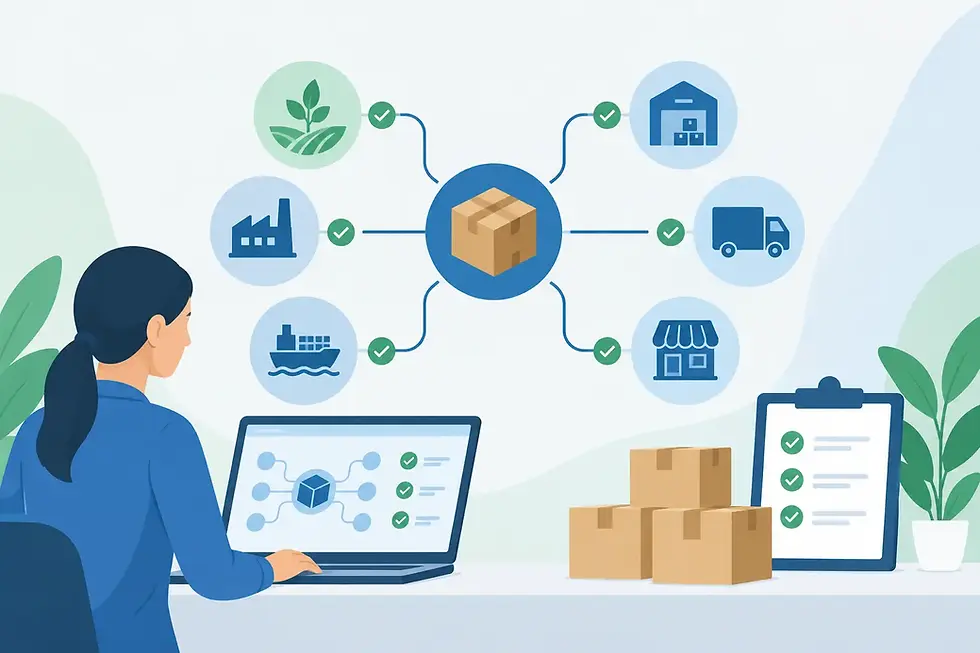
A receiving clerk updates a spreadsheet to show a serialized component in stock. Before the file is saved, purchasing has committed the same unit to a customer order, and quality is waiting for a certification review. None of those people are careless. They are working in a system built around separate files, separate versions, and assumptions. The question of ERP versus spreadsheet operations is not about whether spreadsheets are useful. It is about whether they can remain the operating foundation when inventory, compliance, repair, and financial decisions depend on the same data.
For a parts-driven business, the cost of fragmented information is rarely limited to administrative time. It can mean a shipment held for missing documentation, an incorrect available balance, a repair order that cannot be fully traced, or an invoice based on outdated cost and pricing data. In regulated industries, those failures carry operational, customer, and financial consequences.
Where Spreadsheet Operations Reach Their Limit
Spreadsheets are effective personal productivity tools. They can organize a quick analysis, model a scenario, or support a one-time reconciliation. Smaller organizations often begin with them because they are familiar, accessible, and flexible. The problem begins when a spreadsheet becomes the unofficial system of record for inventory, quotes, work orders, certifications, or revenue.
At that point, a file is no longer just a file. It becomes a shared operational dependency without the controls expected of an enterprise system. Users may maintain multiple versions across departments, change formulas without review, overwrite values, or copy information manually from one file to another. Even a carefully maintained workbook does not inherently understand the relationship between a part number, serial number, lot, purchase receipt, inspection record, customer order, repair event, and general ledger transaction.
That distinction matters in aerospace, defense, electronics, metals, fasteners, power systems, and heavy-duty parts operations. A part may require traceability to a specific source, condition, certificate, customer commitment, and downstream transaction. The business needs to know more than that an item exists in a cell. It needs to know its status, history, location, ownership, and eligibility for sale or use.
Spreadsheets also introduce a timing problem. A report can be accurate when it is created and obsolete minutes later. When sales, purchasing, warehouse, quality, repair, and accounting teams work from their own files, leaders spend too much time reconciling information before they can act on it. The issue is not simply visibility. It is confidence in the visibility.
ERP Versus Spreadsheet Operations: The Control Difference
The practical difference between ERP versus spreadsheet operations is the difference between capturing data and controlling a business process. An ERP system establishes a centralized, transactional record. Each authorized action updates the information other departments rely on, according to defined rules and workflows.
When inventory is received in an integrated ERP environment, the receipt can be connected to the purchase order, supplier, part attributes, lot or serial number, inspection requirement, certification documents, warehouse location, and accounting impact. When that material is allocated to a sales order, transferred to a work order, or issued to a repair process, the system records the next event in its history. Users do not need to rebuild the chain through email, shared folders, and spreadsheet tabs.
This is especially significant where a single part can have multiple conditions, values, or disposition paths. A serialized aviation component, for example, may be awaiting inspection, available for sale, reserved for a customer, installed in a repair workflow, or quarantined due to a quality issue. A spreadsheet can label those states. An industry-specific ERP system can enforce them in the transaction process and prevent inventory from being committed improperly.
The same principle applies to financial control. In a disconnected environment, operations may record activity in one set of files while accounting enters or imports information later. Delays create uncertainty around cost, margin, receivables, inventory value, and period-end reporting. Integrated financials tie operational transactions to the financial record as they occur, giving management a more dependable view of the business.
Traceability Cannot Depend on Manual Reconstruction
For regulated and mission-critical operations, traceability is a working requirement, not a report assembled after the fact. When a customer, auditor, or quality team asks for a component's history, the organization must be able to produce accurate evidence without a prolonged search.
Manual reconstruction is risky because it relies on people finding the right files, recognizing the correct version, and connecting records consistently. It may work for routine questions. It becomes unreliable when the inquiry involves years of transactions, multiple facilities, split lots, serialized inventory, repair cycles, or supplier documentation.
An ERP designed for complex parts operations maintains the relationships as work occurs. Traceability can extend from procurement and receiving through inspection, storage, sales, repair, manufacturing, and shipment. Certifications and quality records remain associated with the relevant transaction and inventory record rather than being managed as disconnected attachments in separate locations.
Embedded compliance capabilities add another layer of control. Requirements such as RoHS and REACH cannot be managed effectively through a periodic spreadsheet review when product status, sourcing, and customer commitments are changing daily. The right system supports compliance within normal operations, where users make purchasing, inventory, and fulfillment decisions.
The Hidden Cost Is Process Variability
The most visible spreadsheet cost is manual entry. The larger cost is process variability. One buyer may use a current pricing workbook while another references an older file. One warehouse team may update stock at the end of the shift while another updates it immediately. One quality manager may store certificates by purchase order, while another stores them by supplier name.
Those workarounds often emerge because people are trying to keep the operation moving. But they make the process dependent on individual knowledge. When an experienced employee is unavailable, changes roles, or leaves the company, the organization discovers how much of its operating logic lived outside its formal systems.
ERP standardizes how work moves from one department to the next. It defines the data required to complete a transaction, creates consistent status controls, and gives each team access to the same underlying record. Standardization does not mean forcing every business into a generic process. It means configuring disciplined workflows around the realities of the operation, including repair management, condition codes, contract pricing, certification requirements, and approval rules.
When Spreadsheets Still Have a Place
Moving to ERP does not require banning spreadsheets. They remain useful for ad hoc analysis, data exploration, budget modeling, and presentations. A controller may use a spreadsheet to evaluate a forecast. A supply-chain leader may model a sourcing scenario. An operations manager may prepare a focused performance analysis for a meeting.
The boundary is straightforward: spreadsheets should analyze information from the system of record, not replace the system of record. They should not be the only place where inventory availability, serialized history, customer pricing, repair status, quality disposition, or financial truth is maintained.
This distinction protects flexibility without sacrificing control. It gives knowledgeable users room to analyze while preserving a dependable source for the transactions that run the business.
Choosing the Right Time to Move
The need for ERP usually becomes clear through recurring symptoms rather than one dramatic event. Inventory counts require extensive reconciliation. Sales staff cannot reliably promise availability. Certificates are difficult to locate. Repair status is tracked through email. Month-end closes depend on manual exports. Leaders receive conflicting reports from different departments.
Growth can intensify these weaknesses, but size alone is not the deciding factor. A relatively focused business with serialized assets, strict documentation rules, or complex repair workflows may need integrated control well before it becomes a large enterprise. Conversely, a simple operation with limited transactions and no traceability burden may continue using spreadsheets for longer.
The right evaluation starts with the operational chain, not a feature checklist. Follow a part from supplier quote to purchase order, receipt, inspection, storage, allocation, repair or production use, shipment, invoice, and financial reporting. Identify every handoff, rekeyed field, offline file, and point where staff must ask another department for confirmation. Those are the places where disconnected tools create exposure.
Pentagon 2000SQL is built for organizations that need this chain managed in one integrated environment. Its purpose is not merely to replace spreadsheet rows with software screens. It is to bring inventory, traceability, quality, compliance, repair, sales, purchasing, and financial activity under disciplined operational control.
The strongest next step is to select one high-risk workflow and map it in detail with the people who perform it. The gaps will show where a centralized system can turn daily uncertainty into reliable, actionable information.