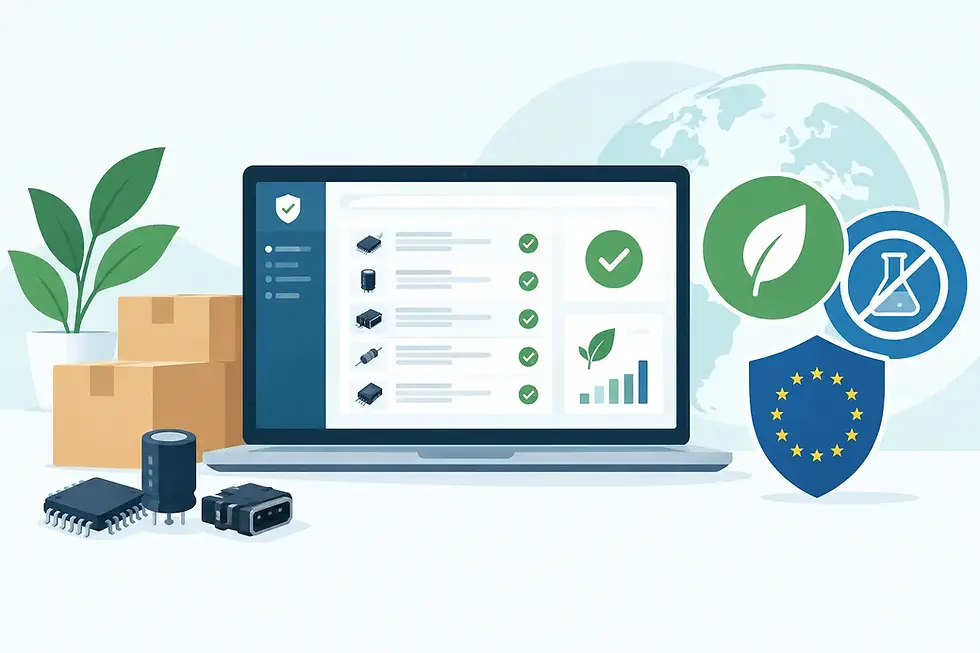
A supplier certificate arrives with an incomplete material declaration. A customer asks whether a specific lot contains an SVHC. Engineering has one answer, purchasing has another, and the warehouse can identify the part but not the exact compliance evidence attached to the received batch. This is the operating gap that RoHS REACH compliance software is built to close.
For aerospace, electronics, automotive, power systems, and other regulated parts businesses, compliance is not a document-storage exercise. It is a data-control requirement that reaches from supplier qualification and purchasing through receiving, inventory, manufacturing, repair, sales, and customer reporting. The organization must be able to determine what was bought, where it was used, which evidence supports it, and what action is required when regulations or supplier declarations change.
Why RoHS and REACH Create an Operational Challenge
RoHS and REACH affect products differently, and each requires disciplined information management. RoHS restricts certain substances in electrical and electronic equipment, while REACH includes obligations related to chemicals, substances of very high concern, and communication across the supply chain. Applicability depends on the product, the markets served, the company’s role in the supply chain, and the current regulatory requirements.
That variability is precisely why spreadsheets and disconnected document folders break down. They may hold declarations, test reports, and supplier correspondence, but they rarely connect those records to the precise part number, revision, lot, serial number, purchase receipt, bill of material, or customer shipment that matters when a question is raised.
The risk is not limited to a failed audit. Incomplete visibility can delay a shipment, complicate a customer response, force unnecessary inventory quarantines, or allow an obsolete declaration to remain attached to an active part. For organizations managing thousands of parts and multiple suppliers, compliance data must operate inside the same system that governs the physical and financial movement of inventory.
What RoHS REACH Compliance Software Must Control
Effective RoHS REACH compliance software creates a controlled record around the part and its supporting evidence. It should enable teams to classify parts by compliance status, maintain supplier declarations and certifications, record relevant material information, and preserve the history needed to explain a determination later.
The critical requirement is context. A PDF labeled with a manufacturer name is not enough. The system should identify which manufacturer part number it covers, the applicable revision or date range, its source, its approval state, and whether it applies to a particular lot or received quantity. When a supplier changes a material composition or a regulatory list changes, the business needs a defined process for identifying affected inventory and open demand.
Part, lot, and serial traceability
A compliance answer is only as reliable as the traceability behind it. Some businesses can manage compliance at the part-number level. Others need control at the lot, heat, date code, or serialized-unit level because sources, revisions, repairs, and material conditions vary.
The software should match the organization’s actual traceability model. A fastener distributor may need manufacturer lot and certification control. An electronics operation may require date-code and supplier-specific material declarations. An aviation MRO operation may need to associate compliance documentation with serialized assets, repair events, and replacement components. Forcing every business into the same record structure creates either unnecessary administrative work or unacceptable blind spots.
Controlled documentation and approvals
Documentation must be available, but availability without governance creates its own problem. Users need to know whether a declaration is current, reviewed, expired, superseded, or pending clarification. Quality and compliance teams need approval controls that prevent unverified claims from being treated as usable evidence.
A mature process also preserves the original supplier document alongside internal compliance classifications and notes. The supplier’s declaration, the date received, the responsible reviewer, and the logic used to assign status should remain connected. This provides accountability when customers, auditors, or internal teams ask how a determination was made.
Visibility across supply-chain transactions
Compliance information has the most value when it informs work before a transaction becomes a problem. Purchasing should be able to see whether an approved source has current declarations. Receiving should be able to hold or flag material that arrives without required evidence. Sales and customer service should be able to respond to requests using controlled data rather than searching email archives.
This is where integration matters. Compliance cannot be isolated from approved-vendor records, purchase orders, receiving, inventory, bills of material, manufacturing orders, repair orders, and shipments. A point solution can collect data, but a connected ERP environment can apply that data to the transactions that determine whether material may be bought, used, allocated, or shipped.
Build Compliance Into the Operating Workflow
The most dependable approach starts before material enters inventory. Establish the compliance attributes and documentation required for each relevant part family, customer program, or market. Then make those requirements visible during supplier selection and purchasing instead of discovering gaps after receipt.
At receiving, the process should validate that required documents and declarations are present, linked to the correct material, and routed for review when necessary. Material with incomplete evidence should follow a defined disposition process. Depending on the organization’s risk policy, that may mean a quality hold, restricted allocation, or conditional acceptance pending supplier clarification.
During manufacturing and repair, traceability must retain the connection between consumed components and the finished or serviced unit. This is especially important where alternate parts, substitutions, mixed lots, or customer-owned material are involved. A compliance status that exists only on a master item record may not reflect the specific inventory that entered the work order.
When a customer requests evidence, the response should be generated from controlled records associated with the sold or serviced item. The goal is not merely to produce a document quickly. It is to produce the correct document, for the correct part and transaction, with a defensible history behind it.
Software Does Not Replace Regulatory Judgment
No software platform can determine compliance without accurate source data and qualified internal decision-making. Supplier declarations can be incomplete. Material composition may change without notice. Regulatory obligations evolve. Legal interpretation can vary based on product category, geography, and the organization’s role as manufacturer, importer, distributor, or repair provider.
The right system supports judgment by making information complete, visible, and controlled. It should identify exceptions, preserve evidence, support review workflows, and make impact analysis practical when requirements change. Compliance leaders still need policies that define acceptable documentation, renewal intervals, escalation paths, and responsibility for final determinations.
Selecting a System for Regulated Parts Operations
Buyers should evaluate more than a software vendor’s ability to store certificates or produce a compliance report. The larger question is whether the platform can maintain a single source of truth across material control, operational execution, and financial records.
Ask how the system handles supplier and manufacturer relationships, part revisions, lot and serial tracking, document approval, inventory holds, and traceability through purchasing, production, repair, and shipment. Determine whether compliance attributes can be associated with the level of detail your operation requires. Also examine reporting and audit capability: can users retrieve the evidence and transaction history without rebuilding the story manually?
For organizations already burdened by disconnected ERP, quality, warehouse, and document systems, integration usually carries more value than another specialized repository. Pentagon 2000SQL ERP brings RoHS/REACH support into a broader operating environment for parts-driven businesses, where inventory traceability, certifications, quality, procurement, repair activity, and financial control must work from the same record.
A standalone compliance tool can be appropriate when the scope is narrow or when a company has a well-integrated enterprise architecture around it. But when compliance status affects what can be received, built, repaired, sold, or shipped, separating it from the core transaction system often creates another handoff and another opportunity for error.
The practical standard is simple: when a customer, auditor, or operations leader asks about a part, the business should be able to trace the answer to controlled evidence and the exact material movement involved. That level of control turns compliance from a recurring search exercise into a managed operating discipline.